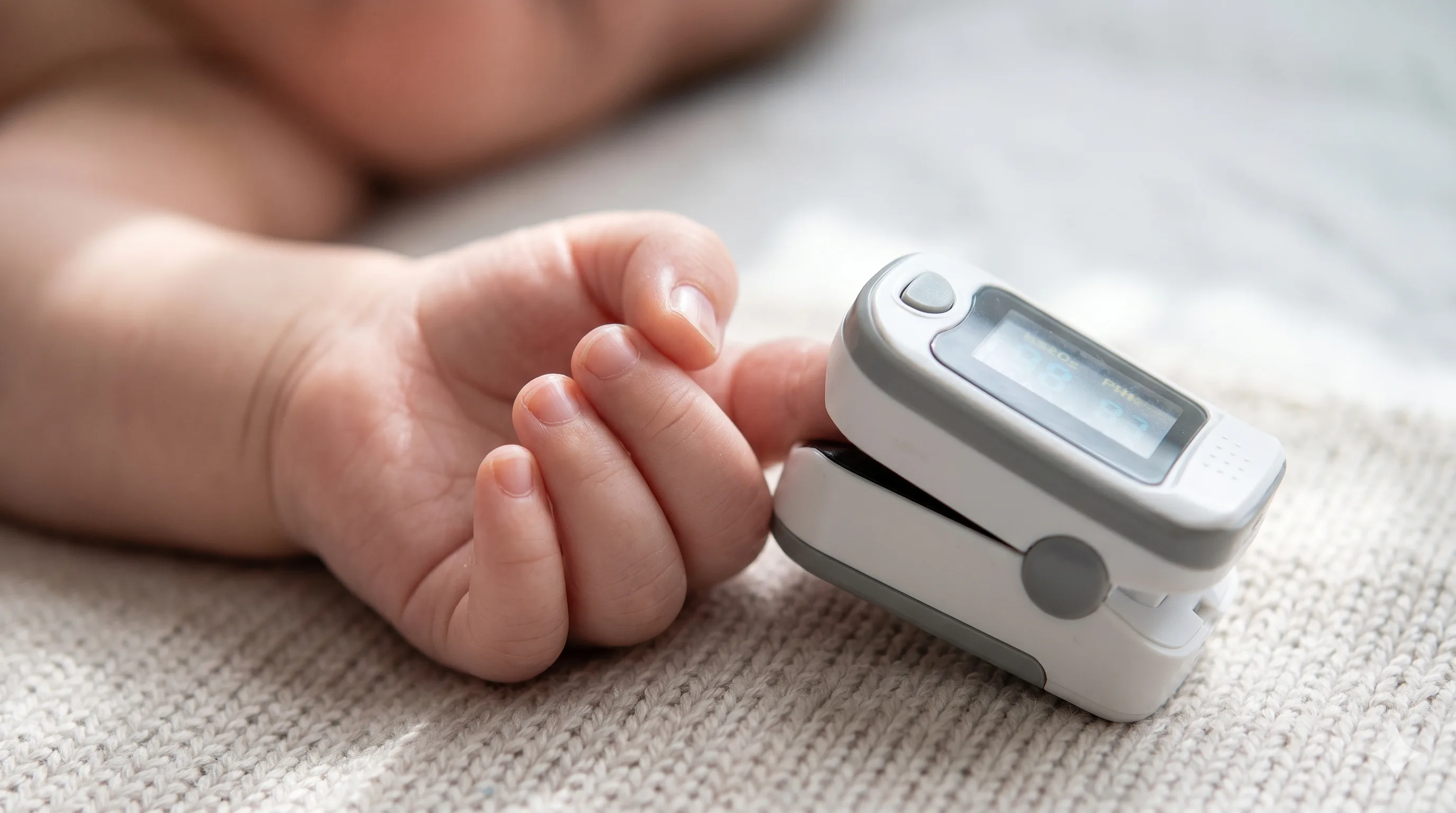
Blood oxygen level — also called oxygen saturation or SpO₂ — measures how much oxygen the blood is carrying to the body. It is checked with a pulse oximeter clipped to a finger or toe. A normal reading in babies and young children is 95% or above.
Illustrative image.
What is a normal oxygen level for babies and young children?
A blood oxygen level of 95% or above is considered normal in babies and young children breathing room air
Healthy babies and children typically have waking oxygen saturation readings of 97 to 98% on average
During sleep, readings may dip slightly — average sleep oxygen saturation in babies under one year is about 96%
In the first 24 to 48 hours after birth, brief dips in oxygen are common as the newborn's lungs and circulation adjust to breathing air
These brief dips become less frequent as a baby gets older
Readings can vary depending on the device, the baby's movement, skin temperature, and how well the sensor is positioned
A single reading is less meaningful than a sustained pattern — context always matters
What can cause oxygen levels to drop in babies and young children?
Viral respiratory infections — such as bronchiolitis, pneumonia, and croup — are among the most common causes of lower oxygen levels in young children
These infections cause swelling and mucus in the airways, making it harder for oxygen to reach the lungs efficiently
Nasal congestion in young babies who breathe mainly through the nose can temporarily affect airflow and oxygen exchange
Asthma flare-ups can narrow the airways and reduce oxygen delivery to the body
Heart conditions present from birth may affect how oxygen-rich blood circulates through the body
Brief dips during sleep are common even in healthy babies
Crying, movement, and poor sensor placement can produce temporarily low readings that do not reflect true oxygen levels
Are home pulse oximeters reliable for checking a baby's oxygen level?
Consumer-grade pulse oximeters are widely available but are generally less accurate than hospital-grade devices
Movement, cold fingers or toes, nail polish, and poor sensor fit can all produce inaccurate readings
A single low reading does not necessarily mean oxygen levels are truly low — repositioning the sensor and rechecking when the baby is calm gives a more accurate result
Darker skin pigmentation may affect the accuracy of some pulse oximeters — some devices have been shown to read slightly higher than actual levels in people with darker skin
Home pulse oximeters can be useful for general observation but do not replace clinical evaluation when a baby appears unwell
Persistent readings below 95% at rest, especially alongside breathing difficulty, are readings worth sharing with a pediatrician
What does a low oxygen level look like in babies?
A reading below 95% that persists when a baby is calm and at rest is low
A reading below 90% is significantly low
Low oxygen combined with fast breathing, chest retractions, grunting, or nasal flaring means the body is working harder to get enough air
Blue or gray color on the lips, tongue, or gums is a visible sign that oxygen levels may be critically low — call 911 immediately
Poor feeding, unusual sleepiness, or reduced activity alongside low readings adds to the concern
In babies with known heart or lung conditions, pediatricians may provide specific oxygen level thresholds to watch for at home
A baby who looks well, is feeding normally, and is alert with a reading of 94% warrants a call to the doctor — a baby who looks unwell with the same reading warrants urgent evaluation
How do pediatricians check and interpret oxygen levels?
Oxygen saturation is measured using a hospital-grade pulse oximeter clipped to a finger or toe — the test is painless and takes seconds
All newborns in the United States are screened with pulse oximetry before leaving the hospital to check for critical congenital heart disease
A normal oxygen reading does not rule out all problems — a baby can have a normal reading and still show signs of breathing difficulty
When oxygen levels are low, clinicians may listen to the lungs, check for signs of infection, and assess hydration and alertness
Continuous monitoring may be used during illness to track trends rather than relying on a single reading
Check Your Understanding
Tap the answer that best fits each scenario.
A 4-month-old is calm and awake. A parent places a home pulse oximeter on the baby's finger and gets a reading of 97%. The baby is feeding well and shows no signs of breathing difficulty.
How would you describe this oxygen reading?
A 7-month-old has had a cough and runny nose for 3 days. A parent uses a home pulse oximeter and gets a reading of 93% while the baby is calm. The baby is breathing faster than usual and the nostrils are widening with each breath.
What does this combination of findings describe?
A 10-month-old is crying hard during a diaper change. A parent clips a pulse oximeter on the baby's finger mid-cry and gets a reading of 91%.
What is the most accurate way to describe this reading?
Hayes D, Wilson KC, Krivchenia K, et al. Home oxygen therapy for children: an official American Thoracic Society clinical practice guideline. American Journal of Respiratory and Critical Care Medicine. 2019;199(3):e5-e23.
Ebenezer Adebiyi, MD, MPH, FAAP
Board-Certified Pediatrician · FAAP · Founder of PediaPulse
Dr. Adebiyi built PediaPulse to help parents understand what they are observing so they can have better, more informed conversations with their own doctors.