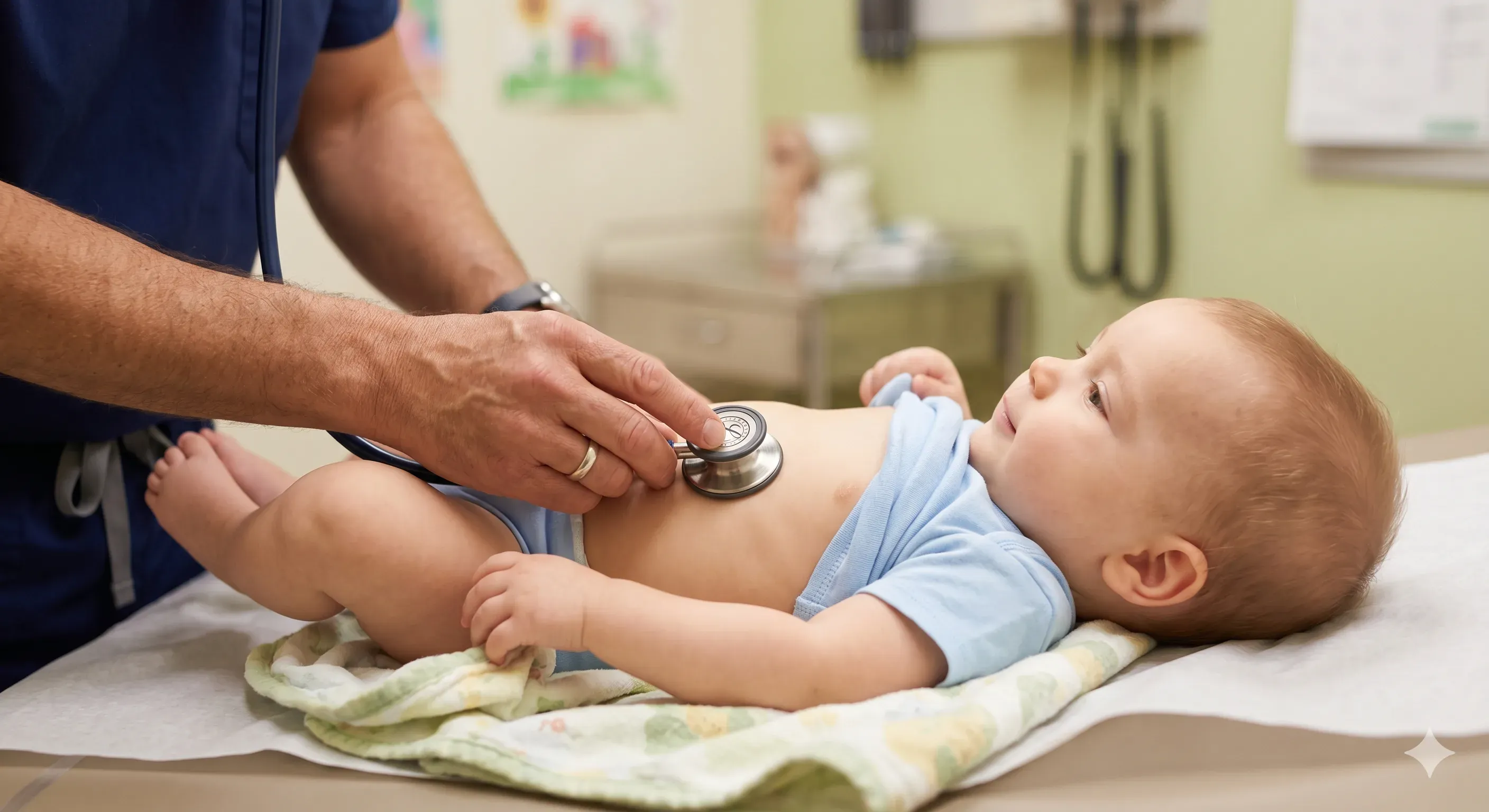
Heart rate — also called pulse — is the number of times the heart beats in one minute. A baby's heart beats much faster than an adult's because the heart is smaller and the body is growing rapidly. Normal ranges change with age and are highest in newborns and premature babies.
Illustrative image.
What is a normal heart rate for babies and young children?
Premature babies typically have a heart rate of 120 to 170 beats per minute
Newborns (0 to 3 months) typically have a heart rate of 110 to 160 beats per minute
By 3 to 6 months, the normal range is 100 to 150 beats per minute
By 6 to 12 months, the normal range is 90 to 130 beats per minute
By 1 to 3 years, heart rate settles to 80 to 125 beats per minute
By 6 to 12 years, the normal range is 60 to 100 beats per minute
Heart rate is naturally higher when a baby is awake, active, feeding, or crying, and lower during deep sleep
Normal ranges are wide — two healthy babies of the same age may have noticeably different resting heart rates
What makes a baby's heart rate speed up or slow down?
Crying, feeding, excitement, pain, and physical activity all temporarily raise heart rate — this is normal and expected
Fever commonly increases heart rate — the heart beats faster to help the body manage the higher temperature
Viral illnesses, ear infections, and other common childhood infections can raise heart rate even before other symptoms appear
Dehydration from vomiting, diarrhea, or poor fluid intake raises heart rate as the body works to maintain blood flow
Sleep naturally slows heart rate, and some variation during sleep is normal
Even a small rise in body temperature can increase heart rate — fever and fast heart rate often appear together
A heart rate that stays unusually fast or slow when a baby is calm and at rest is more significant than a temporary change during activity or crying
See normal heart rate ranges for a specific age
How old is your child?
How can parents check their baby's heart rate at home?
In young babies, the pulse can sometimes be felt by placing two fingers gently on the inside of the upper arm, between the shoulder and elbow
In toddlers and older children, the pulse may be easier to feel on the inside of the wrist, just below the thumb
Count the beats for a full 60 seconds using a clock or phone timer for the most accurate result
The best time to check is when the baby is calm, quiet, and resting — not during crying, feeding, or active play
Some home pulse oximeters also display heart rate, though consumer-grade devices may not always be accurate in small babies
Writing down the number along with the time and what the baby was doing helps track patterns to share with a doctor
What does an abnormal heart rate look like in babies?
A heart rate that stays above the normal range when a baby is calm and at rest — not just during crying or feeding — is fast
A resting heart rate that is below the normal range for age, especially if the baby also looks pale, limp, or sweaty, is slow
A baby who suddenly appears pale, sweaty, or limp alongside a very fast or very slow heart rate needs urgent evaluation
Fast heart rate combined with poor feeding, unusual sleepiness, rapid breathing, or fewer wet diapers adds to the concern
Blue or gray color on the lips, tongue, or gums alongside any heart rate change is a medical emergency — call 911
A baby who is difficult to wake and has a very slow or very fast heart rate needs emergency evaluation — call 911
Brief increases during crying, feeding, or play that return to normal when the baby settles are expected
How do pediatricians evaluate heart rate in babies and young children?
Heart rate is one of the first vital signs measured at every well-child and sick visit, by listening with a stethoscope or using a pulse oximeter
Listening with a stethoscope also allows clinicians to check for abnormal heart sounds, irregular rhythms, or murmurs
If a heart rate concern is identified, an electrocardiogram (ECG) — a painless test using small stickers on the chest — may be used to look at the heart's electrical activity
A small portable heart monitor worn for 24 hours (Holter monitor) may be used to track heart rate patterns over a full day
No single heart rate number tells the full story — pediatricians look at how heart rate relates to activity, sleep, feeding, and behavior
Check Your Understanding
Tap the answer that best fits each scenario.
A 2-month-old is sleeping quietly. A parent uses a home pulse oximeter that also displays heart rate and gets a reading of 118 beats per minute. The baby looks comfortable and is breathing normally.
How would you describe this heart rate?
A 9-month-old has had vomiting and diarrhea for 12 hours and has had fewer wet diapers than usual. A parent notices the baby's heart seems to be beating faster than normal when held.
What is the most likely explanation for the faster heart rate?
A 14-month-old suddenly becomes pale and limp during play. The child is difficult to wake and the lips appear bluish-gray. A parent checks for a pulse and it feels very slow.
Fleming S, Thompson M, Stevens R, et al. Normal ranges of heart rate and respiratory rate in children from birth to 18 years of age: a systematic review of observational studies. Lancet. 2011;377(9770):1011-1018.
Lasa JJ, Dhillon GS, Duff JP, et al. Part 8: Pediatric advanced life support: 2025 American Heart Association and American Academy of Pediatrics guidelines for cardiopulmonary resuscitation and emergency cardiovascular care. Pediatrics. 2026;157(1):e2025074351.
Ebenezer Adebiyi, MD, MPH, FAAP
Board-Certified Pediatrician · FAAP · Founder of PediaPulse
Dr. Adebiyi built PediaPulse to help parents understand what they are observing so they can have better, more informed conversations with their own doctors.