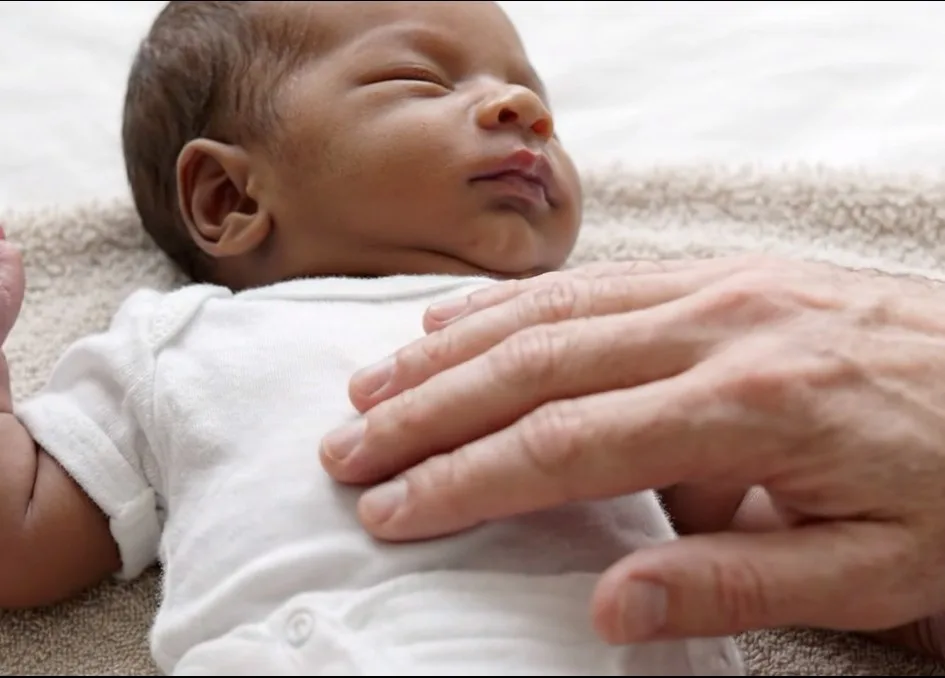
In babies under 12 months, telling the difference between normal fever tiredness and true lethargy can be difficult. Normal fatigue means a baby is sleepier than usual but still wakes to feed, makes eye contact, and reacts when touched or spoken to. True lethargy means a baby is limp, barely responds when picked up, and cannot stay awake long enough to eat. In babies under 3 months, lethargy with any fever requires immediate medical evaluation.
Illustrative image.
Why is this different in babies under 12 months?
Babies under 12 months have a very limited way of communicating distress — sleepiness may be the only visible sign that something serious is happening
In newborns and young babies under 3 months, the immune system is still immature — serious infections like meningitis (infection of the fluid around the brain and spine) or bloodstream infections can develop quickly with very few outward signs beyond sleepiness and fever
Babies have smaller fluid reserves than older children, so dehydration from fever can set in faster and make drowsiness worse in a short period of time
Unlike toddlers who might still play or walk around when mildly sick, a young baby's baseline activity is already limited to feeding, brief alertness, and sleeping — making it harder to spot the shift from tired to lethargic
The younger the baby, the lower the threshold for concern — any baby under 3 months with fever and increased sleepiness needs evaluation without delay
What should parents watch for when a baby seems unusually sleepy with fever?
A baby who wakes briefly when picked up but falls right back to sleep and cannot sustain alertness long enough to feed is showing more than normal tiredness
Skipping feedings or taking less than half of the usual amount of breast milk or formula is a key warning sign in this age group
Fewer wet diapers than normal — especially fewer than four in a 24-hour period — suggests dehydration may be worsening the sleepiness
A weak, high-pitched, or unusual-sounding cry that is different from the baby's normal fussing deserves prompt attention
A soft spot on top of the head that appears sunken (possible dehydration) or bulging (possible pressure inside the skull) is an important visual clue to check
Skin that looks mottled, pale, grayish, or feels cool to the touch on the arms and legs even while the body feels hot is a sign of poor circulation — seek urgent evaluation
Observe alertness, consolability, and activity level
How does your child seem right now?
Rate what you observe on each dimension. This records your observations — it does not score or judge them.
Alertness
Consolability
Activity level
How do pediatricians generally evaluate a baby who is hard to wake with fever?
The doctor will carefully observe how the baby responds to being undressed, touched, and spoken to — this interaction assessment is one of the most important parts of the exam
For any baby under 3 months with fever and increased sleepiness, evaluation typically includes blood tests, a urine sample, and often a lumbar puncture (spinal tap — a test of the fluid around the brain and spine) to rule out serious bacterial infections including meningitis
For babies 3 to 12 months old who appear drowsy but still respond to stimulation, the doctor may start with blood work and urine testing and decide on further steps based on those results
Hydration status is assessed by checking the soft spot, the inside of the mouth, skin elasticity, and wet diaper count
If dehydration is contributing to the sleepiness, intravenous fluids may be given to help restore alertness and fluid balance
Prepare a handoff summary for the doctor
Build your caregiver handoff sheet
Share what you have already observed. The preview updates as you type. Nothing is saved on this page.
Symptoms to note (select all that apply)
Live preview
PediaPulse
Caregiver Handoff Sheet
Your handoff preview will appear here as you type.
A 7-month-old has a fever of 102°F and has been sleeping more than usual. When a parent picks the baby up and speaks in a loud, familiar voice, the baby opens eyes briefly, makes eye contact, then falls back asleep. The baby accepted a small amount of milk when offered.
How would you describe this level of sleepiness?
A 5-month-old has a fever of 101.6°F. Over the past 6 hours the baby has taken less than half the usual amount of milk and has had only one wet diaper. The baby feels slightly limp when held and is difficult to rouse for a feeding.
What do these observations describe together?
A 3-week-old has a fever of 100.6°F and is sleeping more than usual. The baby is difficult to rouse for a feeding. The soft spot on top of the head looks slightly sunken.
How would you describe this situation in a baby this young?
Not every fever is the same—and not every fever needs the same response.
Get pediatrician-designed visual guides and tools like this one, free in the PediaPulse app.
Hamilton JL, Evans SG, Bakshi M. Management of fever in infants and young children. American Family Physician. 2020;101(12):721-729.
Pantell RH, Roberts KB, Adams WG, et al. Evaluation and management of well-appearing febrile infants 8 to 60 days old. Pediatrics. 2021;148(2):e2021052228.
Ebenezer Adebiyi, MD, MPH, FAAP
Board-Certified Pediatrician · FAAP · Founder of PediaPulse
Dr. Adebiyi built PediaPulse to help parents understand what they are observing so they can have better, more informed conversations with their own doctors.