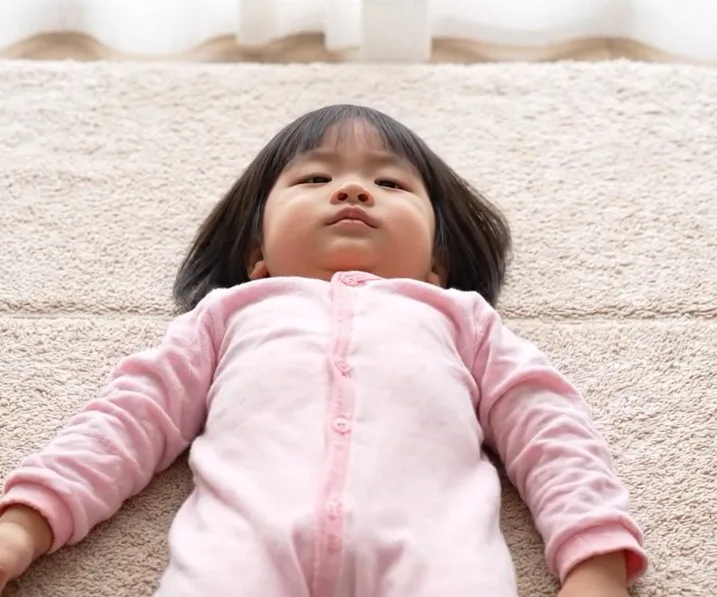
Toddlers between ages 1 and 3 are in the peak age window for febrile seizures — episodes of stiffening, jerking, or staring blankly triggered by a rapid rise in body temperature. These are the most common type of seizure in childhood. Simple febrile seizures in this age group are generally considered harmless, do not cause brain damage, and most children outgrow them completely by age 5 to 6.
Illustrative image.
Why are toddlers at the peak age for febrile seizures?
The toddler brain is at its most susceptible to febrile seizures — the peak age is around 18 months, and the vast majority of febrile seizures occur between 12 and 36 months
Unlike babies under 12 months, toddlers who have a simple febrile seizure generally do not need invasive testing like a spinal tap — current guidelines recommend against routine lumbar puncture, blood work, or brain imaging for a straightforward first febrile seizure in a well-appearing toddler
Toddlers are more likely to have dramatic, recognizable seizures — full-body stiffening followed by rhythmic jerking of all four limbs — making it easier to distinguish from simple chills compared to the subtler signs seen in young babies
A toddler who has had one febrile seizure has roughly a one-in-three chance of having another during a future illness — the risk is higher if the first seizure occurred before 18 months or if there is a family history
What should parents watch for during and after a toddler febrile seizure?
Know the difference between simple and complex — a simple febrile seizure lasts under 15 minutes, involves the whole body equally, and happens only once in 24 hours — anything outside these boundaries is considered complex and needs closer evaluation
The seizure often happens at the very beginning of an illness, sometimes before the parent even realizes the child has a fever — it can be the first sign that the toddler is getting sick
After the seizure ends, expect a recovery period — the toddler may be very sleepy, confused, clingy, or irritable for 30 minutes to an hour — this is a normal part of the brain resetting and not a sign of damage
Watch for a second seizure within the same illness — while one seizure is common and generally harmless, two or more within 24 hours moves it into the complex category and needs evaluation
Fever-reducing medicine helps with comfort but has not been proven to prevent febrile seizures — a seizure can still happen even when medicine has been given on schedule
Describe what the shaking or stiffening looked like
Which description matches what you saw?
Select the observation that best describes the shaking or movement you noticed. Brief shivering while your child stays aware is common with fever; stiffening or rhythmic jerking is a different pattern worth describing clearly.
How do pediatricians generally evaluate toddler febrile seizures?
For a well-appearing toddler with a clear simple febrile seizure, current guidelines recommend focusing on identifying the cause of the fever rather than investigating the seizure itself — this usually means checking for ear infections, throat infections, or urinary infections
Routine brain wave tests (EEG), brain scans, and blood work are generally not recommended after a simple febrile seizure in a toddler — these tests do not predict future seizures and add unnecessary stress
Daily anti-seizure medications are not typically recommended because simple febrile seizures do not cause long-term harm — the side effects of the medications outweigh the benefits for most children
If a toddler has frequent recurrences or a history of prolonged seizures lasting over 5 minutes, the doctor may discuss a rescue medication that parents can give at home to stop a seizure in progress
Simple febrile seizures do not cause epilepsy, do not lead to brain damage, and do not affect a child's development or intelligence — this is an important and well-established clinical fact
Log observations to share with your doctor
Log temperature readings
Enter up to 6 temperature readings with times. The dot plot shows the pattern visually — it does not interpret the readings.
A 20-month-old with a fever of 103.8°F suddenly stiffens, eyes roll back, and arms and legs jerk rhythmically for about 90 seconds. The episode stops on its own. The toddler is now very sleepy but breathing normally. This is the first time this has happened.
What does this episode describe?
A 2-year-old had a febrile seizure this morning that lasted 2 minutes. The child recovered fully and was playing normally by the afternoon. Now, 10 hours later, the toddler has a second seizure lasting 3 minutes during the same illness.
What does a second seizure within 24 hours describe?
A parent of a 2-year-old who had a febrile seizure 6 months ago is worried about a current fever of 102°F. The parent wants to know if giving fever medicine will prevent another seizure.
What does current evidence say about fever medicine and febrile seizure prevention?
Not every fever is the same—and not every fever needs the same response.
Get pediatrician-designed visual guides and tools like this one, free in the PediaPulse app.
Smith DK, Sadler KP, Benedum M. Febrile seizures: risks, evaluation, and prognosis. American Family Physician. 2019;99(7):445-450.
American Academy of Pediatrics, Subcommittee on Febrile Seizures. Neurodiagnostic evaluation of the child with a simple febrile seizure. Pediatrics. 2011;127(2):389-394.
Ebenezer Adebiyi, MD, MPH, FAAP
Board-Certified Pediatrician · FAAP · Founder of PediaPulse
Dr. Adebiyi built PediaPulse to help parents understand what they are observing so they can have better, more informed conversations with their own doctors.