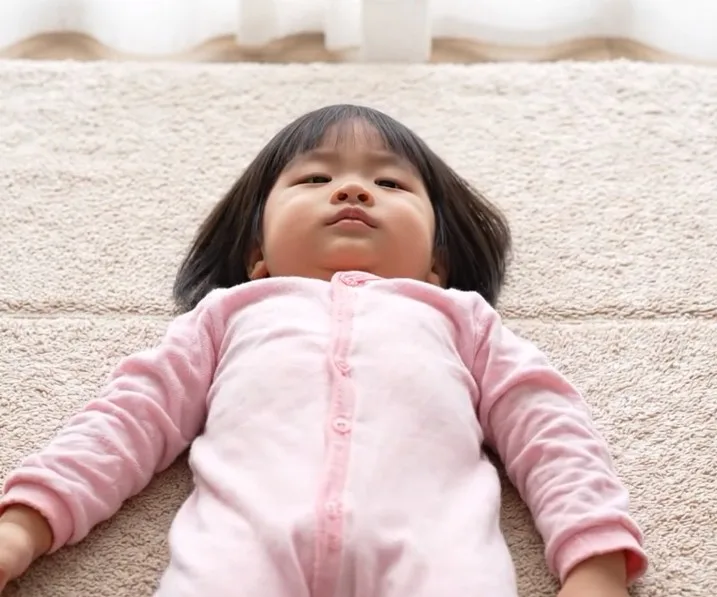
Babies under 12 months who shake during a fever present a unique challenge because normal chills and seizures can look very similar at this age. The critical difference is awareness — a baby with chills will still make eye contact, cry normally, and respond to touch, while a baby having a seizure will be unresponsive and unable to be reached. Any shaking episode in a baby under 6 months with a fever requires urgent medical evaluation.
Illustrative image.
Why is shaking during fever different in babies under 12 months?
Typical febrile seizures are uncommon before 6 months of age — any seizure-like shaking in a very young baby with fever raises higher concern for serious infections such as meningitis or a bloodstream infection
Young babies have more subtle seizure signs than older children — instead of dramatic full-body jerking, baby seizures may look like repetitive lip smacking, eye fluttering, bicycling leg movements, or brief episodes of stiffening
Babies under 6 months cannot shiver as effectively as older children, so visible trembling or shaking during a fever is less likely to be simple chills and more likely to need medical assessment
The younger the baby, the harder it is to judge awareness during an episode — a newborn's baseline responsiveness is already limited, making it difficult to tell if they have stopped responding during shaking
For babies 6 to 12 months, febrile seizures become possible but are still at the younger edge of the typical range — doctors tend to evaluate more thoroughly than they would for an older toddler
What should parents watch for during a shaking episode in a baby with fever?
During the episode, note whether the baby's eyes are tracking or responsive — a baby with chills will still look toward a familiar face, while a seizing baby's eyes may roll upward, deviate to one side, or stare blankly
Watch for color changes — turning blue or very pale around the lips or face during a shaking episode suggests the baby may not be breathing normally and points toward a seizure rather than chills
After the shaking stops, observe recovery — a baby with chills will continue behaving normally, while a baby who had a seizure will typically become very sleepy, limp, or difficult to rouse for a period afterward
Note whether the shaking is fine and trembling (more like chills) or rhythmic and jerky with stiffening (more like a seizure) — and whether it involves the whole body symmetrically or just one side
Any shaking episode in a baby under 6 months with a fever of 100.4°F or higher warrants prompt medical evaluation — even if the baby seems fine afterward
Describe what the shaking or stiffening looked like
Which description matches what you saw?
Select the observation that best describes the shaking or movement you noticed. Brief shivering while your child stays aware is common with fever; stiffening or rhythmic jerking is a different pattern worth describing clearly.
How do pediatricians generally evaluate shaking with fever in babies?
For babies under 6 months, doctors treat any seizure-like episode with fever as a potential sign of serious infection — the standard evaluation typically includes blood tests, urine testing, and often a lumbar puncture (spinal tap — a test of the fluid around the brain and spine) to check for meningitis
For babies 6 to 12 months who had a clear first-time febrile seizure, doctors will focus on finding the fever source and may consider a lumbar puncture depending on vaccination status and how the baby looks clinically
The doctor will perform a careful neurological exam — checking the baby's tone, reflexes, fontanelle (soft spot on top of the head), and responsiveness — to determine whether the nervous system is functioning normally after the episode
If the episode was brief, involved the whole body equally, happened only once, and the baby returned to normal behavior, it is more likely to fit the pattern of a simple febrile seizure in the 6-to-12-month group
Hospital admission for observation is more common for babies than for older children after a febrile seizure — particularly for first episodes and for babies who have not yet completed their primary vaccination series
Prepare a handoff summary for the doctor
Build your caregiver handoff sheet
Share what you have already observed. The preview updates as you type. Nothing is saved on this page.
Symptoms to note (select all that apply)
Live preview
PediaPulse
Caregiver Handoff Sheet
Your handoff preview will appear here as you type.
A 9-month-old has a fever of 102.6°F and is shivering noticeably. The baby is fussy and clingy but makes eye contact when the parent speaks and calms briefly when picked up. There is no color change and the shaking stops after a few minutes.
How would you describe this shaking episode?
A 4-month-old with a fever of 100.8°F has an episode where both legs begin making rhythmic bicycling movements and the eyes flutter rapidly. The baby does not respond to the parent's voice during the episode. The episode lasts about 45 seconds.
What does this episode describe in a baby this age?
An 8-month-old had a shaking episode lasting about 2 minutes during which the whole body jerked rhythmically and the baby was unresponsive. The episode stopped on its own. The baby is now very sleepy and hard to rouse but is breathing normally.
What is the most accurate description of what to do next?
Not every fever is the same—and not every fever needs the same response.
Get pediatrician-designed visual guides and tools like this one, free in the PediaPulse app.
American Academy of Pediatrics, Subcommittee on Febrile Seizures. Neurodiagnostic evaluation of the child with a simple febrile seizure. Pediatrics. 2011;127(2):389-394.
Pantell RH, Roberts KB, Adams WG, et al. Evaluation and management of well-appearing febrile infants 8 to 60 days old. Pediatrics. 2021;148(2):e2021052228.
Ebenezer Adebiyi, MD, MPH, FAAP
Board-Certified Pediatrician · FAAP · Founder of PediaPulse
Dr. Adebiyi built PediaPulse to help parents understand what they are observing so they can have better, more informed conversations with their own doctors.