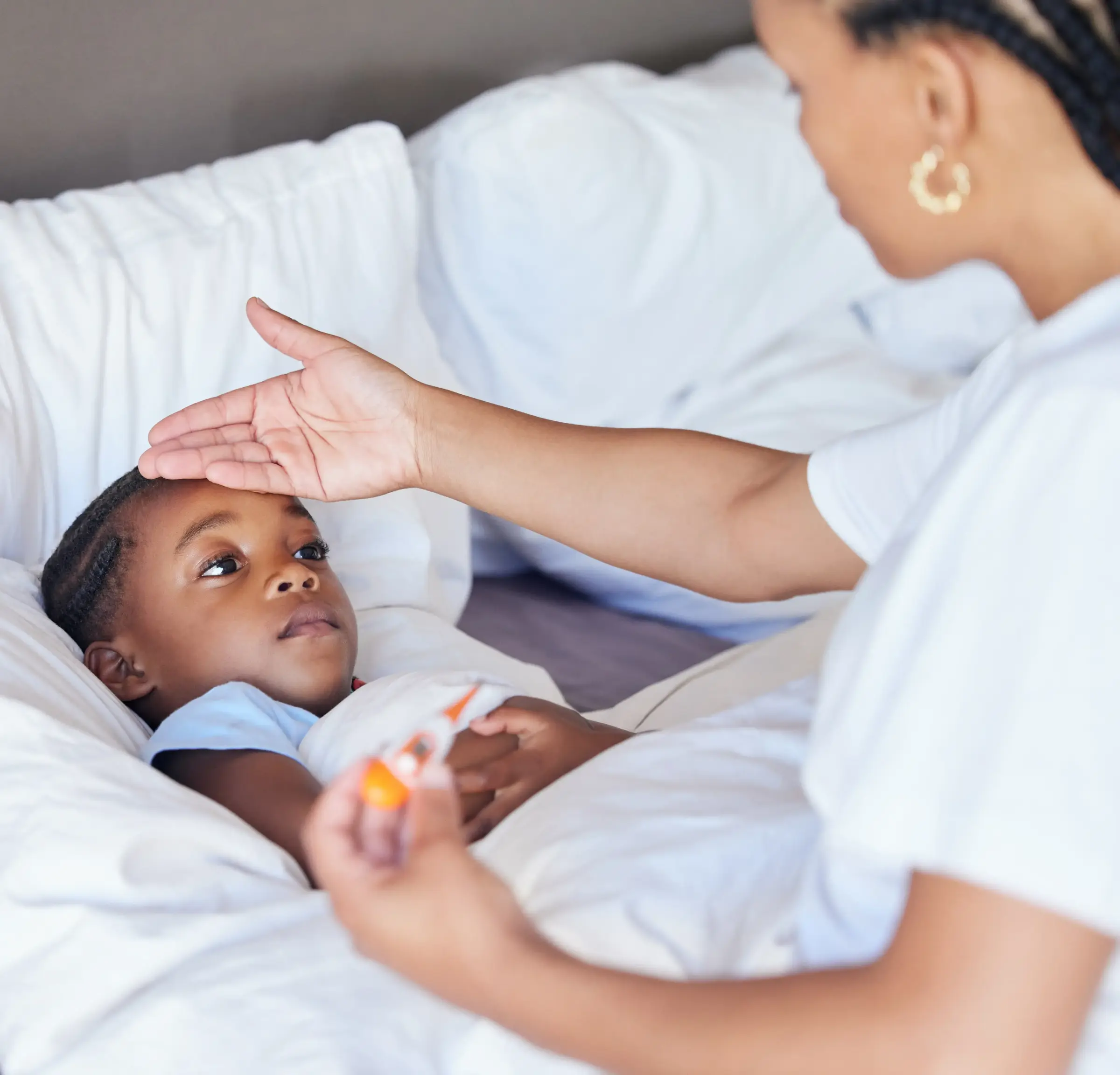
Fever happens when the body raises its internal temperature above the normal range. It is the body's natural defense response to infection — not a disease itself. A temperature of 100.4°F (38.0°C) or higher is a fever at any age and by any method of measurement.
Illustrative image.
What temperature is considered a fever in babies and young children?
A temperature of 100.4°F (38.0°C) or higher is a fever — this threshold applies at any age and by any method of measurement
Normal body temperature generally falls between 97.5°F and 99.5°F (36.4°C to 37.5°C)
Body temperature naturally runs slightly lower in the early morning and slightly higher in the late afternoon and evening
Rectal thermometers are the most accurate method for children under three years old
Armpit readings tend to run about 0.5 to 1°F lower than rectal readings and may miss a low-grade fever
Ear thermometers work best in children over six months — small ear canals in younger babies can affect accuracy
Forehead thermometers are convenient but can vary — they may not be accurate enough for babies under three months
A single slightly elevated reading does not always indicate illness — activity, warm clothing, and recent feeding can temporarily raise temperature
What commonly causes fever in babies and toddlers?
Viral infections — including colds, flu, roseola, and stomach bugs — are the most frequent cause of fever in young children
Approximately three out of four well-appearing children with fever and no obvious source of infection have a self-limited viral illness
Bacterial infections such as ear infections, urinary tract infections (UTIs — infections of the bladder or kidneys), and pneumonia can also cause fever
UTIs are the most common serious bacterial infection in children under three years with fever and no clear source
Vaccines may cause a mild, short-lived fever within 24 to 48 hours — this reflects a normal immune response
Teething may cause a very slight temperature rise, but temperatures of 100.4°F (38.0°C) or higher are not caused by teething alone
Overdressing or overheating can temporarily raise body temperature without indicating infection
Fever itself is not a disease — it is the body's natural defense mechanism to help fight infection
What signs should parents watch for alongside fever?
How a child looks and behaves matters more than the exact number on the thermometer
Reduced feeding or refusal to drink — including breast, bottle, or cup — is a common concern during febrile illness
Increased sleepiness, unusual irritability, or decreased interest in play may accompany fever
Faster breathing and a faster heartbeat are expected with fever — breathing rate may increase by about 10 breaths per minute for each degree Celsius of temperature rise
Fewer wet diapers, dry lips, or absence of tears when crying may suggest reduced fluid intake
Shivering or chills can occur as the body raises its temperature — sweating may follow as the fever breaks
A rash that does not fade when pressed alongside fever is a significant warning sign — call 911 immediately
Stiff neck, bulging soft spot on the head, or difficulty waking are signs that need urgent evaluation
See fever context for your child's age group
How old is your child?
Select an age group to see age-appropriate context for what you are observing.
What fever readings need prompt medical attention?
Any fever of 100.4°F (38.0°C) or higher in a baby younger than three months old requires same-day medical evaluation — regardless of how the baby appears
In babies three to six months old, a fever above 102°F (38.9°C) or any fever lasting more than one day is elevated and warrants a call to the doctor
A child who appears limp, unresponsive, or is difficult to wake needs urgent evaluation — call 911
Fever combined with difficulty breathing, chest pulling in, or grunting needs prompt evaluation
A non-blanching rash — one that does not fade when pressed firmly — alongside fever is a medical emergency — call 911
Fever lasting more than three to five days, even if the child seems otherwise well, is worth describing to a pediatrician
Signs of dehydration alongside fever — no wet diapers for six or more hours, no tears, or a sunken soft spot — add to the concern
The height of the fever alone does not reliably predict how serious the illness is — overall appearance and behavior are more informative
Is your sick day kit ready?
Sick-day readiness check
Answer ten quick questions while your child is well. Your score helps you spot preparation gaps before the next illness.
1. Do you have a working thermometer that every caregiver can find?
2. Do you have an oral syringe or dosing cup for liquid medicines?
3. Are age-appropriate fluids your pediatrician approves easy to locate at home?
4. Could you write a brief plan of symptoms and medicines already given if illness started tonight?
5. Is your pediatrician's phone number saved and posted where caregivers can see it?
6. Do you know the after-hours nurse line or on-call number?
7. Is your preferred pharmacy number saved?
8. Are urgent care or backup clinic numbers posted if your pediatrician advised using them?
9. Do you have a written weight-based dosing reference from your last well visit (if your doctor provided one)?
10. Do you feel confident describing your child's symptoms if you needed to call the nurse line tonight?
How do pediatricians generally evaluate a child with fever?
Pediatricians assess the child's overall appearance, activity level, hydration, feeding, and behavior alongside the temperature reading
A thorough examination typically includes checking the ears, throat, lungs, belly, and skin for signs of infection
In very young babies — especially those under three months — blood tests, urine tests, and sometimes a test of the fluid around the brain and spine may be used to check for bacterial infection
Inflammatory markers — such as C-reactive protein (a protein that rises when the body is fighting infection) and procalcitonin (a marker that helps distinguish bacterial from viral illness) — are sometimes used to help guide evaluation
Older children with a clear source of fever — such as an ear infection or sore throat — may not need additional laboratory testing
Pediatricians consider the child's age, vaccination status, duration of fever, and how the child looks and behaves when deciding on next steps
The goal of evaluation is to determine whether the fever is from a common self-limited viral illness or something that needs specific attention
Log temperature readings to share with your doctor
Log temperature readings
Enter up to 6 temperature readings with times. The dot plot shows the pattern visually — it does not interpret the readings.
Check Your Understanding
Tap the answer that best fits each scenario.
A 5-week-old feels warm. A parent takes a rectal temperature and reads 100.6°F. The baby is feeding and appears alert with no other symptoms.
How would you describe this temperature reading?
A 14-month-old has a temperature of 101.4°F taken with a forehead thermometer. The child is playing normally, drinking fluids, and has no rash or breathing changes.
Which observation best describes what to report to a doctor?
A 2-year-old has had a temperature between 101°F and 103°F for four days. The child is eating less than usual but is drinking fluids and producing wet diapers. There is no rash, no breathing difficulty, and the child is playing between fever spikes.
Pantell RH, Roberts KB, Adams WG, et al. Evaluation and management of well-appearing febrile infants 8 to 60 days old. Pediatrics. 2021;148(2):e2021052228.
Cioffredi LA, Jhaveri R. Evaluation and management of febrile children: a review. JAMA Pediatrics. 2016;170(8):794-800.
Ebenezer Adebiyi, MD, MPH, FAAP
Board-Certified Pediatrician · FAAP · Founder of PediaPulse
Dr. Adebiyi built PediaPulse to help parents understand what they are observing so they can have better, more informed conversations with their own doctors.