A 3-week-old's belly moves quickly with every breath and the chest barely moves at all. The baby is calm, feeding well, and has good color. What is this?
Fast Stomach Movement (Abdominal Breathing)
Babies breathe mainly with their diaphragm — a dome-shaped muscle below the lungs. When the diaphragm contracts, it pushes the belly outward, pulling air into the lungs. This is why a baby's stomach visibly rises and falls with every breath. Belly-dominant breathing is the normal way babies breathe, because their rib muscles are not yet strong enough to expand the chest the way older children and adults do.
A fast-moving belly can be normal in babies — or a sign something needs attention. This guide explains how belly breathing works, what looks normal, what causes faster movement, and when to call your pediatrician.
- Clinical term: Abdominal Breathing
- Parents often search for: baby stomach moving up and down fast, baby belly moving fast when breathing, infant abdominal breathing fast, newborn belly heaving when breathing, baby stomach pumping when breathing
What does normal belly breathing look like in babies?
- In healthy babies, the belly gently rises with each breath in and softly falls with each breath out — this rhythmic movement should look smooth and effortless.
- Newborns breathe 30 to 60 times per minute, so the belly moves noticeably faster than an adult's — this speed is normal and slows gradually as the baby grows.
- The chest may barely move at all in young babies — nearly all visible breathing motion comes from the belly, and this is expected.
- During active sleep, the belly may move at uneven speeds — a few fast breaths followed by slower ones or brief pauses — this irregular pattern is normal.
- The key baseline: the belly and chest should move in the same direction at the same time — belly out and chest slightly out together on each breath in.
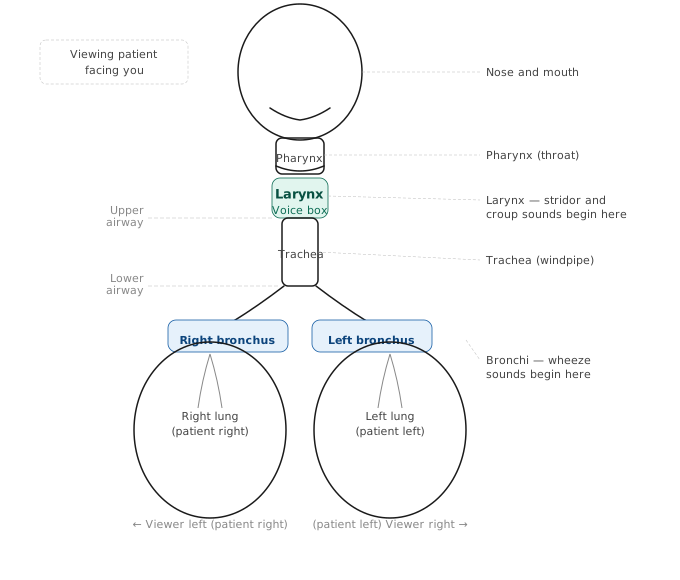
What causes a baby's belly to move faster or harder than usual?
- Fever is one of the most common reasons — a higher body temperature increases the body's demand for oxygen, which speeds up breathing and makes belly movement more noticeable.
- Nasal congestion from a cold can force the baby to work harder to pull air through a stuffy nose, causing the belly to pump more visibly with each breath.
- Respiratory infections such as bronchiolitis or pneumonia increase the effort needed to move air in and out of the lungs, making the diaphragm contract more forcefully.
- Crying, excitement, or physical activity temporarily increases breathing rate and belly movement — this should return to normal once the baby calms down.
- In rare cases, heart or lung conditions present from birth can cause persistently fast or labored belly breathing — these are usually identified in the newborn period or at well-child checkups.
How can parents tell the difference between normal belly breathing and a sign of distress?
- Normal belly breathing looks smooth — the belly rises gently and falls gently, like a small wave, with no jerky or forceful movements.
- In distress, the belly may push outward sharply while the chest sinks inward at the same time — this seesaw pattern means the baby is struggling to move air.
- Look at the spaces between and below the ribs — if the skin pulls inward with each breath, the baby is using extra muscles and working harder than normal.
- Listen for sounds: quiet breathing is normal — grunting with each breath out, wheezing, or a high-pitched squeaking sound when breathing in are warning signs.
- Count the breathing rate during a calm moment: consistently faster than 60 breaths per minute in a newborn, or faster than 50 in a baby over 2 months, may indicate increased effort.
- Check skin color around the lips and fingernails — healthy color is reassuring, while any blue, gray, or pale tint suggests oxygen levels may be low.
What can parents do at home when belly breathing looks faster or harder than usual?
- Remove any extra clothing and observe the bare belly and chest for a full minute while the baby is calm — this gives the clearest picture of actual breathing effort.
- If the baby has a stuffy nose, gentle suctioning with a bulb syringe or a few drops of saline can help clear the nasal passages and reduce breathing effort.
- Hold the baby upright or at a slight incline — this position allows the diaphragm to move more freely and can make breathing easier.
- Count and write down the breathing rate — this number is one of the most useful pieces of information to share with the pediatrician.
- Continue offering regular feeds — a baby who feeds well and produces normal wet diapers is generally coping better than one who refuses to eat.
- Record a short video of the baby's bare chest and belly during breathing — this captures the pattern even if it changes before the doctor's visit.
When should parents call the doctor or seek care?
- Call the pediatrician if the belly is moving noticeably faster or harder than usual and does not slow down after the baby has been calm for several minutes.
- Call the pediatrician if the baby is feeding poorly — taking less than half of normal feeds, pulling off the breast or bottle repeatedly, or falling asleep exhausted after only a small amount.
- Go to the emergency room if the belly and chest are moving in opposite directions — belly pushing out while the chest sinks in with every breath.
- Go to the emergency room if the baby has grunting sounds with every breath, visible pulling-in of the skin between the ribs or at the throat, or any blue or gray color around the lips or fingernails.
- Seek immediate care for any baby under 3 months with a fever of 100.4°F or higher combined with fast belly breathing.
- Trust your instincts — if the baby's breathing pattern looks or feels different from their usual baseline, calling the pediatrician is always appropriate.
Knowledge Check
Tap the answer that best fits each scenario.
A 2-month-old has a cold. Observers notice the belly pushing outward sharply while the chest sinks inward at the same time with every breath. What is this called and what is the appropriate response?
A 5-week-old's belly is moving faster than usual after a bout of hard crying. Five minutes after calming down the breathing is still fast. What is the appropriate response?