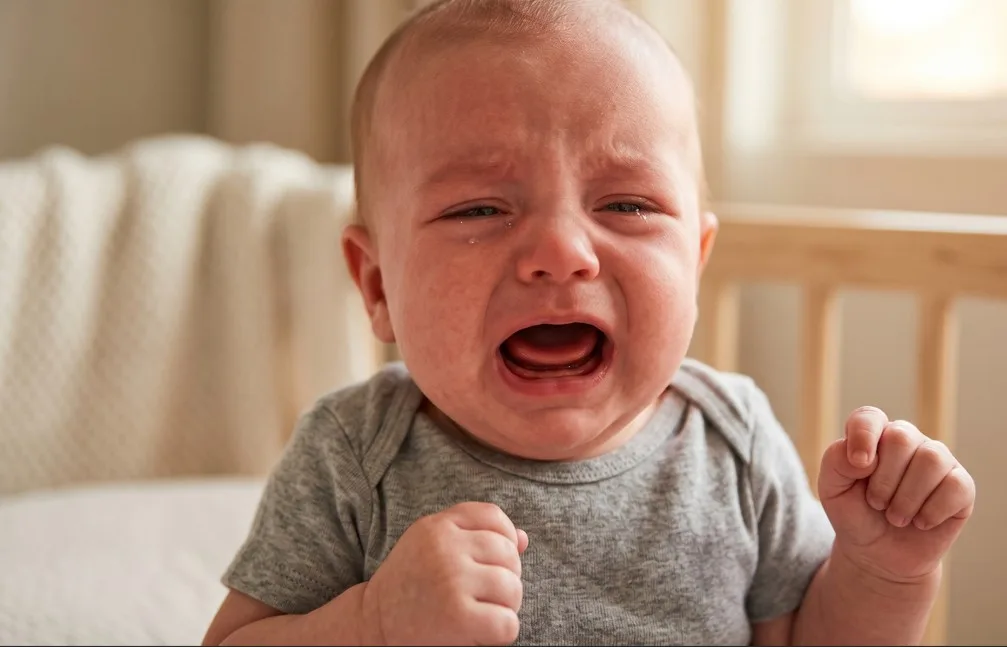
Toddlers between ages 1 and 3 are more expressive than babies, so they can often give clues about what is bothering them — pulling at an ear, holding their belly, or favoring one leg. Some crying and clinginess during a fever is expected at this age. The key distinction is whether a toddler can be comforted at all. A toddler who calms even briefly with holding or distraction is in a different category than one who screams nonstop and cannot be soothed by anything.
Illustrative image.
Why is inconsolable crying with fever handled differently in toddlers than in babies?
Toddlers have a more developed immune system than babies, so the risk of hidden serious bacterial infections is lower — but ear infections, throat infections, and urinary tract infections are very common at this age and can cause intense pain alongside fever
At this age, children are mobile and active, so injuries like a minor fracture from a fall may go unnoticed until a fever from an unrelated illness makes the pain worse and triggers inconsolable crying
Toddlers are at peak age for febrile seizures — a brief episode of shaking triggered by a rapid rise in temperature — which can leave them extremely upset, confused, and difficult to console afterward
Unlike babies, toddlers can often be partially soothed or distracted, so a complete inability to comfort a toddler carries more significance at this age — it narrows down the likely cause
What red flags should parents watch for when a toddler won't stop crying with fever?
A toddler who screams when a specific body part is touched or moved — localized pain reactions help narrow down the source and are important to describe to a doctor
Refusal to walk, limping, or not using one arm — these may point to a joint infection, bone injury, or other musculoskeletal cause of pain
Drooling more than usual combined with refusal to swallow or eat may suggest a severe throat infection or, less commonly, an abscess (a pocket of infection) forming at the back of the throat
Repeated vomiting alongside crying and fever, especially if the belly appears swollen or the child draws knees up during crying episodes
Any new rash appearing with fever — particularly flat red or purple spots that do not turn white when pressed firmly — is a medical emergency — call 911
Describe what the crying looks and sounds like
Describe the crying you observed
Answer each question based on what you saw and heard. This creates a plain-language description to share with a nurse or doctor.
Pitch of cry
Duration
Response to comfort
How do pediatricians generally evaluate a toddler with inconsolable crying and fever?
The doctor observes how the toddler interacts with the room and caregiver — a child who clings to a parent but still looks around and resists the exam with energy is generally more reassuring than one who is limp or unresponsive
Ears and throat are examined closely — middle ear infections and throat infections are among the most common treatable causes of fever with intense crying in this age group
If the child is refusing to walk or move a limb, the doctor may order an X-ray or blood tests to check for a bone or joint problem
A urine sample may be collected — especially in girls or uncircumcised boys — since urinary tract infections in toddlers often present with fever and fussiness rather than obvious urinary symptoms
Most toddlers with a clear source of pain identified on exam — such as an ear infection — are managed with close follow-up, while those with no obvious source and persistent inconsolable behavior may need additional testing
Observe alertness, consolability, and activity level
How does your child seem right now?
Rate what you observe on each dimension. This records your observations — it does not score or judge them.
A 2-year-old has a fever of 101.8°F and has been crying and clinging to a parent for an hour. When offered a favorite snack and a show on a tablet, the child calms briefly, eats a few bites, and watches for several minutes before becoming fussy again.
How would you describe this crying pattern?
An 18-month-old has a fever of 102.4°F and has been crying intensely for two hours. The child keeps pulling at the right ear, is refusing to lie down, and cries harder when the right side of the head is touched.
What does this localized reaction describe?
A 2-year-old has had a fever for two days and is now screaming inconsolably. The parent notices a spreading rash on the arms and chest with flat red and purple spots. The spots do not turn white when pressed firmly.
What does this rash alongside inconsolable crying describe?
Not every fever is the same—and not every fever needs the same response.
Get pediatrician-designed visual guides and tools like this one, free in the PediaPulse app.
Cioffredi LA, Jhaveri R. Evaluation and management of febrile children: a review. JAMA Pediatrics. 2016;170(8):794-800.
Hamilton JL, Evans SG, Bakshi M. Management of fever in infants and young children. American Family Physician. 2020;101(12):721-729.
Ebenezer Adebiyi, MD, MPH, FAAP
Board-Certified Pediatrician · FAAP · Founder of PediaPulse
Dr. Adebiyi built PediaPulse to help parents understand what they are observing so they can have better, more informed conversations with their own doctors.